
Hidden Beats

Your Ultimate Source for Music, Entertainment and Community

Spotlight: Heather Feather

In this edition of Spotlight: Heather Feather, we sit down with the artist to talk about her creative journey, the experiences that continue to shape her music, and the inspiration behind her latest work. From songwriting and artistic growth to the stories that fuel her sound, this conversation offers a closer look at the person behind the music and the path she continues to carve for herself.

As her catalogue continues to evolve, Heather Feather remains focused on creating music that feels authentic to her vision. We discussed her latest release, her influences, and what listeners can expect as she moves forward into her next chapter.

Spotlight: Heather Feather
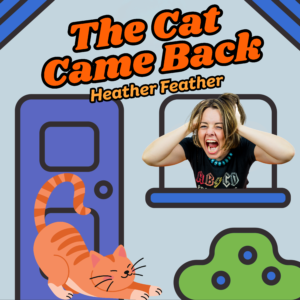
You are coming back into focus with a reimagining of “The Cat Came Back.” What drew you to revisiting something so familiar, and what did you feel was missing from the way it is traditionally presented? 

I have loved this song and all of it’s versions–including the National Film Board version–since I was a child! I also really felt it would sound great as a swing tune, so I wanted to try that. I’m working at a preschool that adores the tune and thought it could also be fun to write new verses for them to giggle at. And finally, I had a kitty that I adored and I had to give her to my sister when she was 8 years old, because my allergies were making me so sick. My son was young, turning 3, and I wished I had a song at the ready to explain it to him, and also make him giggle. 

This version leans heavily into jazz phrasing and swing. How intentional was that stylistic choice when thinking about how young listeners engage with rhythm and repetition?

The style was intentional from a personal choice more than an educational one. The song structure itself has a lot of interior repetition. A lot of children’s music is straight, and not swung, so I wanted to expose them to more swung rhythms. Many of my friends write some great syncopated tunes, but they also tend to be straight as opposed to swung. So for me, early exposure to many musical styles is key in childhood to develop an ear and appreciation for music.

Your work consistently sits at the intersection of music and early childhood development. When you are writing, what comes first, the musical idea or the developmental intention behind it?

The developmental intention always comes first, because most of my songs are educational in so many different ways. There are a few times that the musical idea comes first when I’m working doing something else and it pops into my head. I put those tunes and ideas into a sketch book and they often get used later. In working with younger children, I’m trying to start with the musical idea first for some upcoming songs to challenge myself. Music is fun, first and foremost, and it’s art. For me, art with intention, but first, it’s art.
There is a strong sense of structure in how your songs unfold, especially for younger audiences. How do you balance keeping things simple enough for accessibility while still making it feel musically rich?

I think the structure is really important as a music theorist, because it helps the brain, especially younger brains, to make sense of musical and lyrical development as it interprets faster with a clear structure. There have to be places to make unexpected leaps into another territory to keep it interesting and fresh, for sure. For The Cat Came Back, the structure is incredibly repetitive, so for these songs it’s really crucial to delve into the orchestration and choose a secondary level of interest through instrumentation, timbre, and density: their acceleration/deceleration of rhythm and entry points of musical ideas, left to right listening through time; and their layering and interaction of horizontal structures in shorter time spaces.

You have spoken before about creating music that respects kids’ intelligence. How has that philosophy evolved since your last release, Together?

Respecting children’s intelligence and leaving them room to interpret and grow is critical to me, and always will be. Even when writing a fun tune without a big lesson or moral, or without structured physical movement cues in the music, I still want to leave room to think and explore and to choose how they respond and interpret songs.

This track is aimed specifically at children under five, which is a shift from your previous work. What did that change in audience unlock creatively for you? 

It hasn’t unlocked anything per se, but has posed a challenge to refine and distill what I do in each song, figure out my goal and my own intention, and make sure that there’s not too much packed in there. Having written an album that’s solidly for older children, it’s a big change to write for the very young. Thankfully, I can rely on years of teaching experience with this age group and have many friends that write fabulous music for littles that I can learn from, and I’m truly grateful for that!

There is a personal layer in “The Cat Came Back” tied to your own experience with your cat. How do you decide when and how to bring those real life emotions into something designed to feel playful?

Every hard emotion has feelings of warmth after some time, and although some situations we live through aren’t happy, we can find comfort in happy memories of people we’ve lost and places we’ve been. We laugh as a family when we think of Boots, our kitty, and how special she was and how much joy she brought us, like when she’d bring us little foam soccer balls to play fetch or when she’d walk on a leash like a dog. My favourite funny memory was the time she was scared of a backfiring car outside and jumped to her safe spot at the top of a kitchen cupboard, and knocked a can of rootbeer off the counter. We went into the kitchen and the rootbeer had sprayed over every wall, every cupboard, and every inch of the floor. After we convinced her to come down and gave her lots of reassurance, she was okay. But what a mess! Humour is found in the unexpected and we laugh so hard at that mess now. We can always find something positive in a bad situation, and can choose to find the glimmers in each day when we’re blue, and I made sure I raised my son knowing that. 

You have worked with Grammy winning collaborators on this project. What do those collaborations bring to your process that might not exist if you were working in a more isolated space?

Talent and creativity! Dean Jones comes up with new ideas sometimes that I’d never thought of, reinterpreting one of my songs into a totally different style, for example. Adding his own meowing voice through a sampler. He’s hilarious and spontaneous, and when I’m too bogged down with thinking too hard he adds something zany and we meet in the middle. His experience is a real gift and I’m honoured he chose to give me a chance and work with me.

With your background in music theory, how do you avoid overthinking the technical side and stay connected to instinct and feel?

It’s really, really hard, lol! I find that I have to sit with a guitar and try non-traditional voicings and tunings like Joni Mitchell. Or start from a technical place and think of a harmonic progression I’ve not heard very much and intentionally use it and see what comes to mind. In that second case, I’m using the training to intentionally find something unexpected and push myself into an unknown space.

Your music is often described as both educational and entertaining, which is harder than it sounds. Where do you feel that tension most during the creative process? 

Thankfully no! It honestly is just such a part of who I am as a person, a mix of educator and creative.

You have been gaining more national visibility recently, including TV appearances. Has that exposure changed how you think about your role as an artist in this space? 

In many ways it doesn’t change a thing: I’m still me, a somewhat shy, introverted musician and teacher who loves working with kids in smaller spaces where we make real connections. In other ways it has changed how I see myself, because it changes how others see me: I was recently on a tour in the Toronto area, and one of the students asked me if I was famous. I just froze, because obviously, no, I’m just me. So I told the student I think of myself as a regular person and asked them what they thought “famous” meant…and it turns out that their benchmarks of fame were ones I met, and so I chuckled a little and the French teacher yelled out, “yes, she’s famous.” Then we all laughed really hard.

Looking at your trajectory from Songs for Growing to Together and now this new phase, how do you think your music has evolved coming into this project? 

I am much more introspective about what and how I write. I sit with songs for much longer. I edit much more. I’m not afraid to put a sketch away for a year and return with fresh ears a year later when I’m in a different space. More and more, I think about the longevity, value, and impact of what I’m writing and want to make sure that each song has a purpose.

What is one thing you have learned about yourself during this process that you did not expect? 

I learned to be less nervous and more confident. Honestly, I remember finishing a PhD and thinking, “that’s it? Now I’m an expert?” The more you learn, the more you realize that you don’t know and will never know. It’s very humbling. Being a performer and a songwriter is the same, regardless of formal education: the more you hone your craft, the more you realize there is out there, for you to try, and new goals that you set for yourself to grow and develop as a person and an artist. But now I’ve finally found a bit of confidence to temper that, thankfully!

As you continue building this next chapter, what feels most important for you to explore that you have not yet touched?

Ooo! There’s so much! I’d really love to explore more genres, more kinds of mixing and remaking what’s expected and creating links between what I would write in a classical composition in a popular tune, yet still keep it catchy and accessible, and most of all, fun music that kids and families want to come back to again and again.

ClosingThank you for reading Spotlight: Heather Feather, our conversation with an artist who continues to bring her own perspective and creativity to every release.

  • Artist: Heather Feather
  • Genre: Children’s Music
  • Location: Montreal, Quebec
  • Latest Release: The Cat Came Back