Hidden Beats

Your Ultimate Source for Music, Entertainment and Community

Spotlight: Dee Hernandez

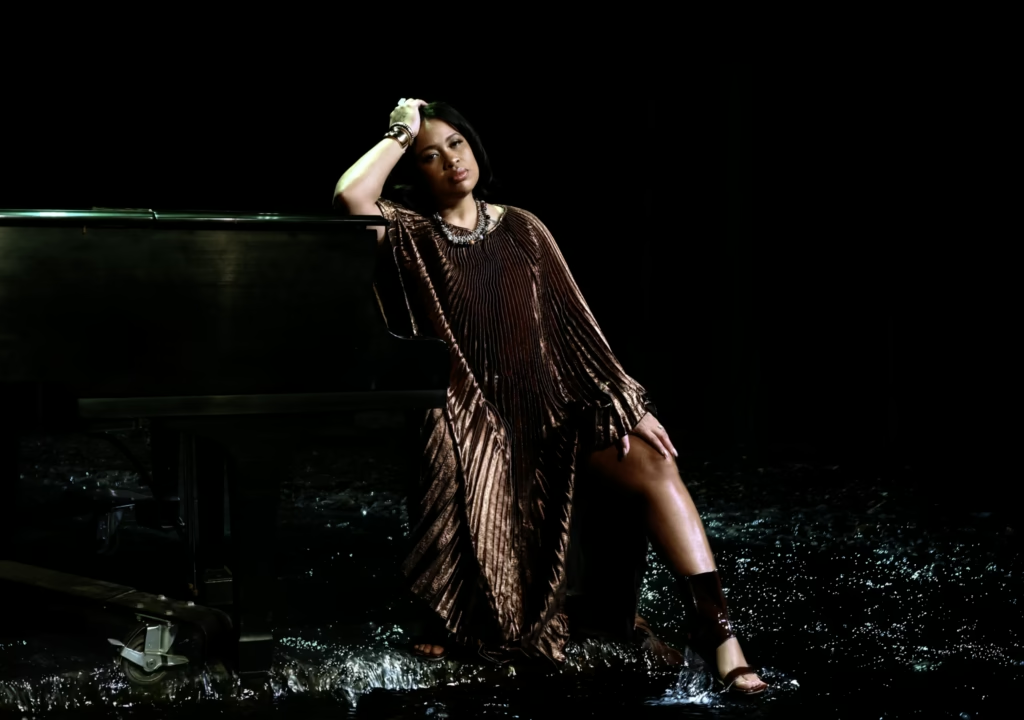
Dee Hernandez is an artist who continues to carve out her own lane through honest songwriting and a sound that blends emotion with contemporary pop influences. In this edition of Spotlight: Dee Hernandez, we sit down with the emerging artist to discuss her creative journey, the stories that inspire her music, and the release of her latest single, Used. From her approach to songwriting to the lessons she’s learned along the way, Dee offers an inside look at the experiences shaping this current chapter of her career.

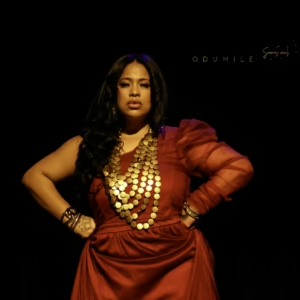
“Odumile” feels like it’s coming from a deeply personal and spiritual place—when you listen back to it now, what does that moment in your life sound like to you?

When I listen back now, Odumile feels like a messagefrom my ancestors, from the divine, the universe, reminding me that everything was going to be okay, that we are stronger that we think. That moment in my life feels very abstract when I think about it now. Time felt like it stood still, but everything was moving extremely fast. It was a blur. The moment felt very chaotic and Odumile became the clarity. It was born as a prayer, but also as confirmation and faith. 

You’ve described the track as something that began as a poem, at what point did it shift from something private into something meant to be shared?

It shifted the moment the words stopped feeling private and started feeling necessary. I don’t believe in coincidences — I’ve experienced many synchronicities and repeating patterns, often because I ignored my gut. The songs wrote themselves; I didn’t have to force them. They found their way onto the page in a way I’d never experienced before, and the music came the same way. So, during a time of uncertainty and fear, if music came to my rescue… who am I to question it? 
There’s a strong sense of ancestry and connection running through the song. How did you approach translating something so internal and cultural into a sound that others can feel, even if they don’t share that same background?

I believe there is no language that can separate us from our soul or feeling since music is universal. It connects directly to something deeper. I approached Odumile honestly and without fear of judgement. It was a way to remind myself of who I am and that truth carries emotion, even for listeners who don’t share my exact background.  

Having lived in Canada most of my life, I’ve questioned my own authenticity at times, and other have too. But I’ve come to understand that our stories are carried in our DNA, the stories of those who came before us. And across cultures those stories often share the same themes of resilience, strength and survival. 

That’s what translatesFeeling is what connects us 

You handled the layered vocal arrangements yourself—what drew you to building those choir-like textures, and what did that process unlock creatively?

In Cuba I attended a music Conservatory where I studied choral conducting for a couple of years and I’ve carried that foundation with me ever since. I took what I learned there and applied it as much as I could in my music. With Odumile, I was drawn to building those choir-like voices where living within the harmonies. Even the echoes in the song feel intentional, like reflections of self and spirit. 

On the creative side, that process allowed me to step outside of a single perspective and create something more collective and immersive. Less about the voice leading and more about channelling something bigger and with weight. 

Writing during such an intense personal period can change how you relate to your own work. What is one thing you’ve learned about yourself during this process you didn’t expect?

I’ve learned that my strength doesn’t come from having everything figure out, it comes from trusting myself in the unknown. 

didn’t expect to discover that I could hold so much at once. Fear, responsivity, faith and still move forward with clarity.  There was a moment where I had no choice but to lead emotionally and spiritually, and I realized I was more prepared than I thought. 

Your sound blends Afro-Cuban roots with jazz and soul in a way that feels very intentional rather than experimental. How do you decide what elements belong in a song versus what gets left behind?

For me, it’s always start with the feeling and then the song tells me what it needs. The sounds are usually in my head when I am writingI first hear a bass line and then everything else – I can hear the horn lines, the basic rhythm, the movement of the song before anything is fully built. 

Once I have the song, many times, I’ll lean on the musicians I work and that exchange has been important because they can help take what I am hearing and expand it.  

My Cuban roots, Jazz and Soul, are not elements I consciously try to blend, they are part of who I am. So, when I am creating, it’s more about listening thadeciding.  

You’ve been performing for most of your life, across different countries and stages, how has your relationship with your voice changed over time, especially heading into this debut album era?

Very early in my career, my focus was very much on having a big voice, the range, the power and being the girl with the big voice 0 that was my identity as a young singer in Cuba. 

Over time, that relationship has evolved. I started to explore and embrace part of my voice I once overlooked or even disliked. Instead of only chasing power, I became more interested in texture and expression. 

I am constantly looking to improve and grow in any way I can, but I’ve also become very aware and grateful for what I already naturally have. Especially now in this AI era where so much can be replicated or enhanced. I feel even more grounded in the importance of what is real and human in my voice. That authenticity is something I protect and continue to deepen. 

Being nominated for an East Coast Music Award at this stage in your career adds a different kind of spotlight. Has that recognition shifted how you view your place in the Canadian music landscape?

I think about something I once told my oldest son, that sometimes you have to be so undeniably good that people can’t overlook you, even if they try. In my own journey, I’ve understood that deeply. Being nominated for an East Coast Music Award at this stage of my career is an honour, but it also reflects years of building something without a clear lane for me in this region. I didn’t step into an existing path. I had to create it through consistency, trust in my vision and a lot of work. 

So rather than changing how I see myself, this recognition feels more like visibility catching up to effort. I do have support within the industry, but I have learned that you must become so solid in your craft that it speaks for you when the space isn’t naturally built for you. 

Your recent Ella Fitzgerald tribute tour connects you to a very specific legacy in jazz, how does honouring artists like her influence the way you approach your own original material?

Honouring Ella connects me to a very specify legacy of discipline, elegance and emotional truth in Jazz. It isn’t about imitation, It’s about respect for the craft. Ella Fitzgerald had a way of making something technical and complex feel effortless and deeply human at the sometime. That stays with me. 

When I approach my own original material I think more about the intention, thathe performance. How does the song breathe? How does it speak emotionally, not just musically? 

It reminds me that I am part of a lineage. Even when I am creating something new, I am standing on the shoulders of artists who opened space for expression in ways that weren’t always easy. 

As you build toward your debut album, how do you ensure that each release, like “Odumile”, feels like part of a larger narrative rather than a standalone moment?

With Odumile, I wanted it to serve as an entry point into a larger journey, rather than just a standalone moment. I even imagined it being almost like a ritual, similar to using sage, so the listener is invited into a different emotional and spiritual space before the story unfolds. 

From there the song became a kind of condensed narrative of my life, moving from my arrival in Canada through various personal and artistic transitions, up to the person I am becoming now. 

What keeps it cohesive is honesty. I don’t approach each release as a separate piece; I stay grounded in where it comes from and what it represents in the larger arc of my story. 

So, even though each song can stand on its own, together they feel like chapters. The project as a whole moves more like a book than individual songs, each one revealing a different layer of the same journey. 

How do you think your music has evolved from your earlier work coming into this new project?

My music has gone through a real evolution. Earlier on, there was a strong sense of experimentation, leaning to different global sounds and exploring where my voice could exist within different musical worlds. 

With this album, the focus feels different. It’s more of a return to self, to roots. Sometimes you have to be away from home to understand what home means and I think that’s what shifted for me. 

Your music often carries themes of migration and identity without feeling heavy-handed. What’s your approach to storytelling when the subject matter is so personal?

Every migration story hits different, but for me it wasn’t only about leaving—it was about seeking myself, seeking opportunity, and stepping into a dream I feel I’m still fulfilling today. In many ways, it feels like the dream I had as a child. 

Even though there were real challenges within that experience, I also gained a kind of “toolbox” from itlessons, resilience, perspectivethat have only strengthened me. 

I think what makes the story telling feel lighter in my music is that I approach it from a place of acceptance and joy. I came into those experiences eager to learn and to live them fully, and that openness shapes how I translate them into sound. 

So even where there is pain or struggle in the story it’s never just heaviness. Its movement, its rhythm. My music still has space to dance, and I thank that balance is what allows people to connect with it in a more universal way.  

What is one thing you think should be asked more in an interview that isn’t asked enough?

I think we often ask artists about the end result, but not enough about the emotional cost and the discipline behind staying true to your voice over time. That part of the journey is just as important as the music itself.

Looking ahead to the full album release, what feels most important for you to communicate in this next chapter?

What feels most important for me in this next chapter is really showing what it took to be here today. 

This project carries the full weight of my journey: the discipline, the transformation, the moments of doubt, and the moments of faith that kept me going. It’s not just about arriving at a funky sound or a new era, it’s about everything that shaped me into the artist I am right now. So, what I want to communicate is that none of this is accidental. There is intention, history, and lived experience behind every choice. And I think this album reflects that truth in a very direct way. 

Read on as Spotlight: Dee Hernandez explores the music, motivation, and mindset behind one of her newest releases.

  • Artist: Dee Hernandez
  • Genre: Pop
  • Location: United States
  • Latest Release: Odumile